Hospital-Acquired Conditions: CMS Definition, 14 Categories, and Penalty Data
Hospital-acquired conditions (HACs) are medical conditions that patients develop during a hospital stay and that were not present on admission. Under the Deficit Reduction Act of 2005, CMS tracks 14 HAC categories affecting Medicare payment. Hospitals in the worst-performing quartile — roughly 25% of all eligible hospitals — take a 1-percent Medicare payment reduction under the HAC Reduction Program.
What are hospital-acquired conditions?
Hospital-acquired conditions as defined by CMS are a specific set of 14 medical categories used for Medicare payment purposes — distinct from the broader clinical concept of healthcare-associated infections (HAIs). Under the Deficit Reduction Act of 2005, Section 5001(c), CMS identified 14 categories of hospital-acquired conditions for which hospitals do not receive additional Medicare payment when the condition was not present on admission. The defining feature is timing: a condition counts as a HAC only when it develops during the inpatient stay rather than being carried in by the patient.
Statutory definition under the Deficit Reduction Act of 2005
The Deficit Reduction Act of 2005 directed the Secretary of Health and Human Services to identify conditions that are high-cost or high-volume, that result in a higher-paying diagnosis-related group (DRG) when present as a secondary diagnosis, and that could reasonably have been prevented through the application of evidence-based guidelines. CMS implemented the provision beginning October 1, 2008. From that date, when one of the listed conditions is acquired during a stay, Medicare no longer assigns the case to the higher-paying DRG that the condition would otherwise trigger.
The three CMS criteria for HAC classification
CMS uses three statutory tests to add a category to the HAC list: the condition must be high-cost, high-volume, or both; it must lead to a higher-paying DRG when reported as a complication or comorbidity; and it must be reasonably preventable through the application of evidence-based care. A category that meets these tests is added to the list, and the associated ICD-10 diagnosis codes are published annually so that hospital coders and payers apply the provision consistently.
How HACs differ from healthcare-associated infections (HAIs)
HACs and healthcare-associated infections (HAIs) overlap but are not the same. A HAI is a clinical concept — an infection a patient contracts in the course of care. A CMS HAC is a payment-policy category: one of 14 defined events that change how Medicare pays for a case. Several of the HAC categories are infections, and five infection measures feed the separate HAC Reduction Program score, but the HAC list is a regulatory construct used to administer Medicare payment, not a clinical taxonomy. Throughout this page, the term refers to the CMS policy category.
The 14 HAC categories CMS tracks
CMS categorizes 14 types of hospital-acquired conditions under the Deficit Reduction Act of 2005; payment for these conditions does not increase when a HAC was not present on admission. The full list, with the specific conditions each category covers, is below.
| # | Category | What it covers |
|---|---|---|
| 1 | Foreign Object Retained After Surgery | Instrument or material unintentionally left in the body. |
| 2 | Air Embolism | Gas introduced into the vascular system during care. |
| 3 | Blood Incompatibility | Transfusion of ABO-incompatible blood products. |
| 4 | Stage III and IV Pressure Ulcers | Advanced pressure injuries developed in the facility. |
| 5 | Falls and Trauma | Fractures, dislocations, intracranial, crushing, burn, and other injuries. |
| 6 | Manifestations of Poor Glycemic Control | Diabetic ketoacidosis, nonketotic hyperosmolar coma, hypoglycemic coma, and secondary-diabetes events. |
| 7 | Catheter-Associated Urinary Tract Infection (UTI) | UTI linked to an indwelling urinary catheter. |
| 8 | Vascular Catheter-Associated Infection | Infection linked to a vascular access device. |
| 9 | Surgical Site Infection Following CABG | Mediastinitis after coronary artery bypass graft. |
| 10 | Surgical Site Infection Following Bariatric Surgery | Infection after bariatric surgery for obesity. |
| 11 | Surgical Site Infection Following Certain Orthopedic Procedures | Infection after specified orthopedic operations. |
| 12 | Surgical Site Infection Following Cardiac Implantable Electronic Device (CIED) | Infection after CIED implantation. |
| 13 | DVT/PE Following Certain Orthopedic Procedures | Deep vein thrombosis or pulmonary embolism after specified orthopedic operations. |
| 14 | Iatrogenic Pneumothorax with Venous Catheterization | Pneumothorax caused during venous catheter placement. |
How CMS updates the HAC list and ICD-10 mappings
CMS revisits the HAC list through annual Inpatient Prospective Payment System (IPPS) rulemaking and publishes ICD-10 HAC code lists by fiscal year so that the payment provision maps cleanly onto current diagnosis coding. When coding standards change, the ICD-10 HAC lists are revised to keep the 14 categories defined precisely. The categories themselves have been stable, while the underlying code mappings are refreshed each fiscal year.
How the HAC payment provision works
The DRA HAC provision turns on a single data field: the Present on Admission (POA) indicator. Every diagnosis on an inpatient Medicare claim carries a POA flag stating whether the condition existed at the time of admission. When a listed HAC is flagged as not present on admission, CMS pays the case as though that complication had not occurred.
The Present on Admission (POA) indicator
The POA indicator is what lets CMS separate conditions a patient arrived with from those that developed during the stay. If a HAC was present on admission, normal DRG payment applies. If it was acquired during the stay, the case is grouped as if the secondary diagnosis were absent — removing the payment uplift the complication would otherwise generate.
DRG payment mechanics for HAC cases
Medicare pays inpatient stays through diagnosis-related groups. A serious complication usually moves a case into a higher-paying DRG. The DRA HAC provision withholds that uplift for hospital-acquired cases: the case is assigned to the lower-paying DRG that reflects the absence of the acquired complication. The provision affects payment for the individual case; it is not a hospital-wide penalty.
Effective date: October 1, 2008
The DRA HAC payment provision has applied to Medicare fee-for-service discharges since October 1, 2008. It is the older of the two CMS programs that share the "HAC" label, and it operates case by case rather than through an annual hospital ranking.
The HAC Reduction Program: how CMS penalizes hospitals
The HAC Reduction Program, established by the Affordable Care Act Section 3008, penalizes the worst-performing quartile of hospitals with a 1-percent reduction in Medicare payments. It is a separate program from the DRA payment provision and works at the hospital level rather than the individual-case level.
Statutory authority: ACA Section 3008
Section 3008 of the Affordable Care Act added the HAC Reduction Program to the Social Security Act at 42 U.S.C. § 1395ww(p). The program took effect in FY2015 (beginning October 1, 2014). Each year CMS ranks eligible hospitals on a Total HAC Score and reduces payments for the bottom quartile.
Which hospitals are subject to the program
The HAC Reduction Program applies to subsection (d) hospitals — the general acute-care hospitals paid under the Inpatient Prospective Payment System. These are the same hospitals whose cost and quality data Fonteum tracks across the federal source families.
Which hospitals are exempt
A number of hospital types are exempt from the HAC Reduction Program, and Maryland hospitals are specifically exempt from payment reductions under the program. The full exemption set:
- Critical access hospitals
- Rehabilitation hospitals and units
- Long-term care hospitals
- Psychiatric hospitals and units
- Children's hospitals
- PPS-exempt cancer hospitals
- Veterans Affairs hospitals
- Hospitals in U.S. territories
- Religious nonmedical health care institutions
- Rural emergency hospitals
- Maryland hospitals (state payment-model exemption)
The six quality measures CMS uses
The Total HAC Score is the equally weighted average of six quality measure scores: one claims-based composite (CMS PSI 90) and five CDC NHSN healthcare-associated infection measures. The claims-based composite is drawn from Medicare fee-for-service billing data; the five infection measures — CLABSI, CAUTI, SSI, MRSA bacteremia, and CDI — are reported by hospitals to the CDC National Healthcare Safety Network. They appear here as program inputs, not as clinical prevention topics. The full measure table is in the FY2026 data section below.
How the Total HAC Score is calculated, and the 75th-percentile threshold
Hospitals with a Total HAC Score above the 75th percentile of all eligible hospitals take a 1-percent payment reduction on all Medicare fee-for-service discharges for the fiscal year. A higher Total HAC Score is worse. Because the threshold is a relative ranking against the national distribution rather than a fixed clinical target, the worst-performing quartile is penalized each year by construction. CMS paused use of all HAC Reduction Program measures in the FY2023 program year because of COVID-19 data disruption.
The AHRQ National Scorecard on Hospital-Acquired Conditions found that HACs fell by 13 percent from 2014 to 2017, saving an estimated 20,700 lives and $7.7 billion in healthcare costs. An earlier CMS analysis covering 2014–2016 reported 8,000 lives and $2.9 billion in avoided costs over that shorter window.
How many hospitals are penalized
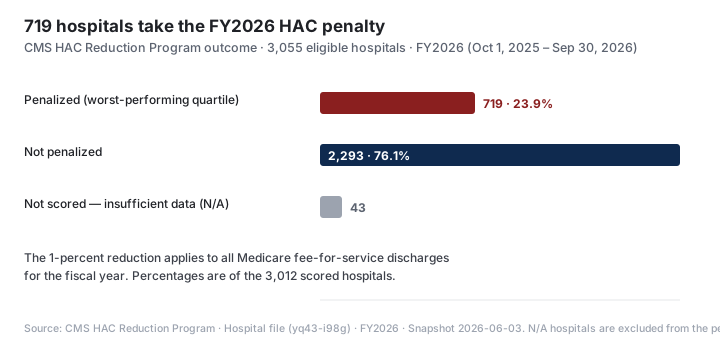
For FY2026, CMS scored of 3,055 eligible hospitals on the Total HAC Score. Of those, hospitals — 23.9% of scored facilities — fall in the worst-performing quartile and take a 1-percent reduction in all Medicare fee-for-service payments for the fiscal year. 2,293 hospitals are not penalized, and 43 had insufficient data to be scored (recorded as N/A, not as a pass). Because a hospital recorded N/A has no quartile determination, Fonteum and CMS both compute the penalty rate against the 3,012 scored hospitals — never against the full 3,055.
The Total HAC Score is the equally weighted average of six measure scores. A higher Total HAC Score is worse — it ranks a hospital nearer the penalized quartile. The measurement windows differ by measure family: the claims-based PSI 90 composite covers discharges from July 1, 2022 through June 30, 2024, while the five CDC NHSN infection measures cover January 1, 2023 through December 31, 2024.
| Measure | What it captures | Domain | Reported to |
|---|---|---|---|
| CMS PSI 90 | Patient Safety and Adverse Events Composite | Domain 1 — claims-based | Medicare claims (AHRQ methodology) |
| CLABSI | Central Line-Associated Bloodstream Infection | Domain 2 — chart-abstracted | CDC NHSN |
| CAUTI | Catheter-Associated Urinary Tract Infection | Domain 2 — chart-abstracted | CDC NHSN |
| SSI | Surgical Site Infection (colon + abdominal hysterectomy) | Domain 2 — chart-abstracted | CDC NHSN |
| MRSA | Methicillin-resistant Staphylococcus aureus bacteremia | Domain 2 — chart-abstracted | CDC NHSN |
| CDI | Clostridioides difficile Infection | Domain 2 — chart-abstracted | CDC NHSN |
See the full facility-level HAC reduction program penalty data by hospital, combine it with CMS hospital cost report (HCRIS) data, or browse every feed in the source catalog.
How Fonteum tracks HAC data
The same CMS Hospital file underlies every HAC explainer on the web. Fonteum publishes the facility-level figures with a per-field provenance chain, while the common alternatives stop at a raw download or a definitional glossary entry.
| Source | Data grain | Cadence | Access | Provenance |
|---|---|---|---|---|
| Fonteum | Facility (CCN) HAC scores + penalty status | Annual (FY) | Free, web + provenance chain | 14-tuple chain |
| CMS data.cms.gov | Facility (CCN), raw file | Annual (FY) | Free flat file, no analysis layer | Source file only |
| AHRQ National Scorecard | National / selected conditions | Periodic, ends 2017 | Free, PDF-first | None |
| Definitive Healthcare | Facility glossary entry | Editorial | Paid product ecosystem | None |
Methodology
The FY2026 figures are read directly from the CMS HAC Reduction Program Hospital file on data.cms.gov — not from an aggregator. The pipeline runs in five stages: (1) source acquisition from the CMS provider-data metastore, (2) entity resolution on the 6-character CCN, (3) field extraction (Total HAC Score, the six component measures, and the payment-reduction determination), (4) quality checks against the published CMS counts, and (5) chain attestation. Each value is asserted and chained, then labeled with its provenance — attested, signed, or provenance-tracked — never with unbacked trust language. A null measure value with a footnote is treated as suppressed, not as zero.
These four headline fields begin the 14-tuple provenance chain — full contract on the data sources reference and the read-only methodology library.
Sources
- Hospital-Acquired Conditions (DRA Payment Provision) — Centers for Medicare & Medicaid Services (CMS), Updated as rules change. Primary source ↗ · Archive ↗
Used for: Statutory basis (Section 5001(c), DRA 2005), the 14 HAC categories, the Present on Admission indicator, and the October 1, 2008 effective date. - Hospital Acquired Conditions (Value-Based Programs / HACRP) — Centers for Medicare & Medicaid Services (CMS), Annual program year. Primary source ↗ · Archive ↗
Used for: HACRP program structure, the six quality measures, exemptions, Total HAC Score definition, the 75th-percentile threshold, and the 1-percent payment reduction. - HAC Reduction Program — Hospital file (yq43-i98g) — Centers for Medicare & Medicaid Services (CMS) · data.cms.gov, Annual (by federal fiscal year). Primary source ↗ · Archive ↗
Used for: FY2026 facility-level Total HAC Score, component measure scores, and the worst-quartile payment-reduction determination for 3,055 hospitals. - Deficit Reduction Act Hospital-Acquired Condition Measures dataset — Centers for Medicare & Medicaid Services (CMS), Annual (R/P1Y). Primary source ↗ · Archive ↗
Used for: DRA HAC measure rates reported for informational and quality-improvement purposes (these do not affect payment and are distinct from the HACRP scores). - National Scorecard on Hospital-Acquired Conditions — Agency for Healthcare Research and Quality (AHRQ), Periodic scorecard. Primary source ↗ · Archive ↗
Used for: Context on HAC trends: a 13% decline from 2014 to 2017, an estimated 20,700 lives saved, and $7.7 billion in avoided costs.
Data last updated: 2026-06-03 · Reviewed by Jennifer Montecillo, MD · June 2026. Non-practicing medical reviewer.
Frequently asked questions about hospital-acquired conditions
- What are hospital-acquired conditions?
- Hospital-acquired conditions (HACs) are medical conditions that patients develop during a hospital stay that were not present on admission. Under the Deficit Reduction Act of 2005, CMS identifies 14 categories of HACs for which hospitals do not receive additional Medicare payment when the condition was not present on admission.
- What are the 14 hospital-acquired conditions tracked by CMS?
- The 14 CMS HAC categories are: foreign object retained after surgery, air embolism, blood incompatibility, stage III and IV pressure ulcers, falls and trauma, manifestations of poor glycemic control, catheter-associated UTI, vascular catheter-associated infection, surgical site infection after CABG, after bariatric surgery, after certain orthopedic procedures, and after cardiac device implantation, DVT/PE after orthopedic procedures, and iatrogenic pneumothorax with venous catheterization.
- How does CMS penalize hospitals for high HAC rates?
- Under the HAC Reduction Program (ACA Section 3008), CMS calculates a Total HAC Score for each eligible hospital annually. Hospitals with a Total HAC Score above the 75th percentile — the worst-performing quartile — take a 1-percent reduction in all Medicare fee-for-service payments for that fiscal year. The FY2026 program covers discharges from October 1, 2025, through September 30, 2026.
- Which hospitals are exempt from the HAC Reduction Program?
- Exempt hospitals include critical access hospitals, rehabilitation hospitals, long-term care hospitals, psychiatric hospitals, children's hospitals, PPS-exempt cancer hospitals, Veterans Affairs hospitals, hospitals in U.S. territories, religious nonmedical health care institutions, and rural emergency hospitals. Maryland hospitals are also specifically exempt from the payment reduction.
- What is a Total HAC Score?
- A Total HAC Score is the equally weighted average of a hospital's scores on six measures: the CMS PSI 90 composite (10 patient safety indicators from Medicare claims) and five healthcare-associated infection measures reported to the CDC National Healthcare Safety Network — CLABSI, CAUTI, SSI, MRSA bacteremia, and CDI. A higher score is worse; hospitals above the 75th percentile take the penalty.
- How is the HAC Reduction Program different from the DRA HAC payment provision?
- The DRA HAC payment provision (Deficit Reduction Act of 2005, Section 5001(c)) removes the additional DRG payment when one of 14 HAC categories occurs without being present on admission. The HAC Reduction Program (ACA Section 3008, effective FY2015) is a separate program that reduces the worst-quartile hospitals' payments by 1 percent across all Medicare discharges — not just cases with a HAC.
- How many hospitals receive HAC penalties each year?
- CMS penalizes roughly the worst-performing quartile of eligible subsection (d) hospitals each fiscal year. In FY2026, 719 of 3,012 scored hospitals (23.9%) are in the worst-performing quartile and take the 1-percent payment reduction, out of 3,055 eligible hospitals; 43 had insufficient data to be scored. CMS paused all HAC measures in the FY2023 program year because of COVID-19 data disruption.
Looking for the hospital-by-hospital figures? See the HAC Reduction Program penalty data, FY2026, explore more healthcare policy explainers, or read Fonteum healthcare research studies.